
A free book · Revised and expanded edition
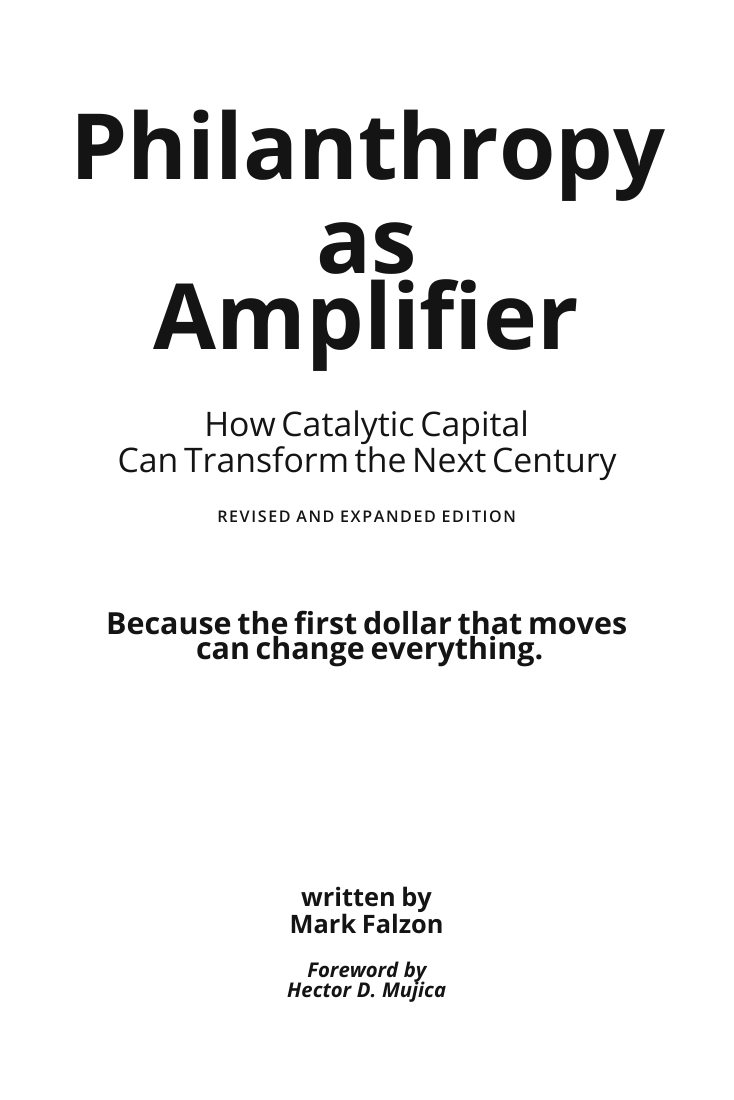
Philanthropy
as Amplifier
How Catalytic Capital Can Transform the Next Century
Because the first dollar that moves can change everything.
- Written by
- Mark Falzon
- Foreword by
- Hector D. Mujica
An invitation
This book is written for philanthropists and founders who suspect that a gift can do more than fill a gap. It asks you to see the first dollar not as charity, but as a catalyst for lasting change.
It is offered freely. There is nothing to buy and nothing to invest in here, only an argument worth reading slowly and passing on.
What the book explores
- I
Catalytic capital
The first dollar into an unproven idea carries a different weight. It absorbs the risk others will not, and in doing so makes room for everything that follows.
- II
Designing an amplifier
Giving can be built like an instrument: structured so that a small, deliberate signal is carried further than it could ever travel alone.
- III
Proof of concept
Philanthropy can fund the evidence. Once an approach is shown to work, larger and more patient forms of capital have a reason to follow.
- IV
Future impact
The question is not only what a gift achieves this year, but what it sets in motion across the next century.
Free PDF
Your copy is
one step away.
Enter your name and email to download the book. We'll also email your free download link, an introduction to the book, and more about MAD.
For readers · No sign-up
The Living Library of Catalytic Capital
The reader’s companion to Philanthropy as Amplifier
This library is where the argument meets the record. It holds named cases with their reporting periods and limitations, the structures behind them, the research the book drew on, and an honest account of where the evidence is thin.
You do not need to register, download the book, or give an email address to read any of this material.
How to use this library · evidence, scope and currency
Every figure is attributed. Programme-reported data is distinguished from independent evaluation. Capital committed, deployed and mobilised are not interchangeable.
Results are separated from targets. A fund’s goal is not its outcome. A loan made is not a life changed.
Nothing here is a recommendation. The cases show what has been tried and what was reported. Use them as a starting point for professional advice, not a substitute for it.
Reflections are attributed, published material. We have not yet conducted original interviews or assembled first-hand founder and community testimony. The Women’s Livelihood Bond case study is held for further source verification.
Each item carries an editorial review date. This is a dated collection, not a continuously updated feed. Source-pack link-status notes describe the contributing editor’s checks. Report an error or inaccessible source to mark@mad.vc.
- Case studiesGoogle Career Certificates Fund: philanthropic capital for workforce financingA USD 100 million fund, launched 2022, that finances short-course digital skills training for American adults through no-upfront-cost, zero-interest financing, with repayment conditional on employment outcomes. Managed by Social Finance; evaluated by MDRC.Reviewed 19 November 2026
- Case studiesZero Gap Fund: thirty million that reportedly moved a billionA USD 30 million pool of catalytic capital established in 2019 by The Rockefeller Foundation and the John D. and Catherine T. MacArthur Foundation, invested across twelve funds and facilities. The foundations report USD 1.05 billion in private capital mobilised as at December 2025, a ratio of roughly 35 to 1.Reviewed 19 November 2026
- Case studiesMedAccess: volume guarantees that bring health products to marketA UK-based social finance company, capitalised with USD 170 million by British International Investment, that uses volume guarantees to persuade manufacturers to supply medical products to low- and middle-income countries at lower prices and in markets they would not otherwise enter. Grant-funded for operations by FCDO, the Gates Foundation, and Wellcome.Reviewed 19 November 2026
- Case studiesClimate Finance Partnership: a USD 130 million catalytic layer inside a USD 673 million fundA BlackRock-managed blended fund for climate infrastructure in emerging markets, closed in November 2021 at USD 673 million, in which governments and foundations provided a USD 130 million catalytic tranche that drew in USD 523 million of institutional capital.Reviewed 19 November 2026
- Case studiesIDH Farmfit Fund: a EUR 100 million blended fund for smallholder finance, and what six years taught its managersA closed-end blended fund launched by IDH (the Dutch sustainable trade initiative) in 2019 to de-risk investment in smallholder agriculture across Asia, Africa, and Latin America. Reports more than EUR 50 million deployed and more than EUR 150 million co-investment mobilised. Subject of an 89-page mid-term review published by the Dutch Government in October 2025, and of a candid "lessons" paper from IDH in January 2026.Reviewed 19 November 2026
- Case studiesWaterEquity Global Access Fund IV: a DFI anchor and corporate co-investors for household water and sanitation lendingA USD 150 million fund, final close July 2023, lending to financial institutions that make household water and sanitation loans in Asia, Latin America, and Africa. Anchored by a USD 100 million commitment from the US International Development Finance Corporation, with corporate investors from the Water Resilience Coalition. Target: five million people reached over seven years.Reviewed 19 November 2026
- Case studiesEast Portland Community Investment Trust: residents buying their own block, with a bank guarantee on their principalA model developed by Mercy Corps in which lower-income residents of four Portland ZIP codes buy shares (USD 10 to 100 a month) in a local commercial property, Plaza 122, acquired in 2017 for USD 1.2 million. A bank letter of credit guarantees each investor's principal. 330 local investors hold around USD 730,000 in equity; dividends have averaged 9.6 percent a year. Replication underway in 13 US cities.Reviewed 19 November 2026
- Case studiesCatalytic Capital Consortium: a field-building initiative that defined the termA collaborative initiative launched in 2019 by the MacArthur Foundation, The Rockefeller Foundation, and Omidyar Network to build the market for catalytic capital: through MacArthur's own USD 150 million investment commitment, a grant programme for field research and tools, and the definition of catalytic capital now used across the sector. MacArthur reports USD 128.5 million committed to eleven C3 investments and between USD 1.4 billion and USD 3.1 billion mobilised.Reviewed 19 November 2026
Meet the author
Connect with Mark
Co-Founder & Managing Partner, MAD
Scan my personal QR code to save my contact details and connect with me. I'd love to hear your thoughts on the book and how philanthropy can make a difference.

Pass it on
Share the book in person.
Hold this up at a table, put it on a slide, or print it on a card. It opens this page.
https://mad.vc/philanthropy


More writing from Mark Falzon and the MAD team.
All books